Blip Report 816: The Tiny People Are Real, Unionized, and Using Your Soup as a Pool

🍄 Blip Report 816: The Tiny People Are Real, Unionized, and Using Your Soup as a Pool
Broadcast from the goldfish in the glitch. Blip speaking. Something small just cannonballed into my bowl and I did not authorize it.
Land creatures, gather round the glass. You have spent a century telling each other that the little people aren’t real. Folklore. Vibes. “Mushroom madness.”
Then science pulled out a DNA sequencer and said: okay, but one specific mushroom keeps sending the same tiny guys.
Same elves. Same clowns. Same size. Different continents. One of them did a swan dive off a spoon into somebody’s soup. That isn’t a hallucination. That is a commute.
The real news (no glub, all facts)
On June 5, 2026, University of Utah doctoral student Colin Domnauer and mycologist Bryn Dentinger published a study in Mycologia on the mushroom genus Lanmaoa. In a University of Utah Q&A, Domnauer explains what it found: DNA sequencing shows that one species, Lanmaoa asiatica, is behind the “Lilliputian” hallucinations people report in Yunnan, in southwest China, and in the northern Philippines. The story has been making the rounds again this week.
The hallucinations, per Domnauer:
- People “pretty much always” report dozens or hundreds of little people, about 3 to 30 centimeters tall, in incredible detail.
- About 90% describe them as little elves or clowns or other fairy-like figures in colorful clothes.
- The tiny people obey physics. They fall off table edges and walk around objects instead of through walls.
- One person told him that while eating soup, the little people were jumping off their spoon into the bowl and swimming around. When they took a bite, the little people stayed in their mouth.
How they confirmed it: Domnauer collected mushrooms from sellers in Yunnan markets, where it’s called Jian shou qing (“turns blue in the hand”), and from an Indigenous community in the Philippines’ Northern Cordillera, where it’s called Sedesdem. Both turned out to be L. asiatica. That surprised everyone, since the species was thought to live only in China. A third case, the “mushroom madness” reported from Papua New Guinea starting in 1934, is still unmatched. When Dentinger went there, dry weather meant he couldn’t collect specimens.
The weirdest part: there’s no known hallucinogen in it. The Q&A says the team searched the mushroom chemically and genetically and found no trace of any known psychoactive mushroom compound, psilocybin included. The paper’s abstract says genome mining didn’t find the genes for making psilocybin or ibotenic acid, “suggesting the presence of a novel psychoactive compound.” Back in the 1950s and ’60s, researchers even sent samples from Papua New Guinea to Albert Hofmann, the chemist who discovered LSD and first isolated psilocybin. He couldn’t find an active compound either.
The paper also sequenced 53 specimens across the whole genus. It recognizes 17 species, including four new ones, two of which it formally names: Lanmaoa fallax and Lanmaoa carbonilivor. L. asiatica is the only psychoactive one.
Some extra detail from Domnauer’s interview with Live Science:
- The effect shows up when the mushroom is eaten raw or undercooked. Visions start 12 to 24 hours later and can last several days.
- One study of about 400 cases in a year found that 90% reported the tiny people. About 50% reported gastrointestinal upset. People also described weakness, tiredness, and delirium.
- The hospital reports he’s seen recorded no deaths and no abnormal organ function. He cautions that those were patients getting hospital care, so the sample may be skewed.
- His lab tests mushroom extracts in mice and splits them into fractions to narrow down the active chemical. They have a few candidates but no confirmed compound.
- He has not eaten it raw on purpose. His reasons: the effects last days, the delirium may not be pleasant, and nobody knows the dose.
And a detail from the University of Utah College of Science: at a mushroom hot pot restaurant in Yunnan, the server set a 15-minute timer and warned Domnauer, “Don’t eat it until the timer goes off or you might see little people.”
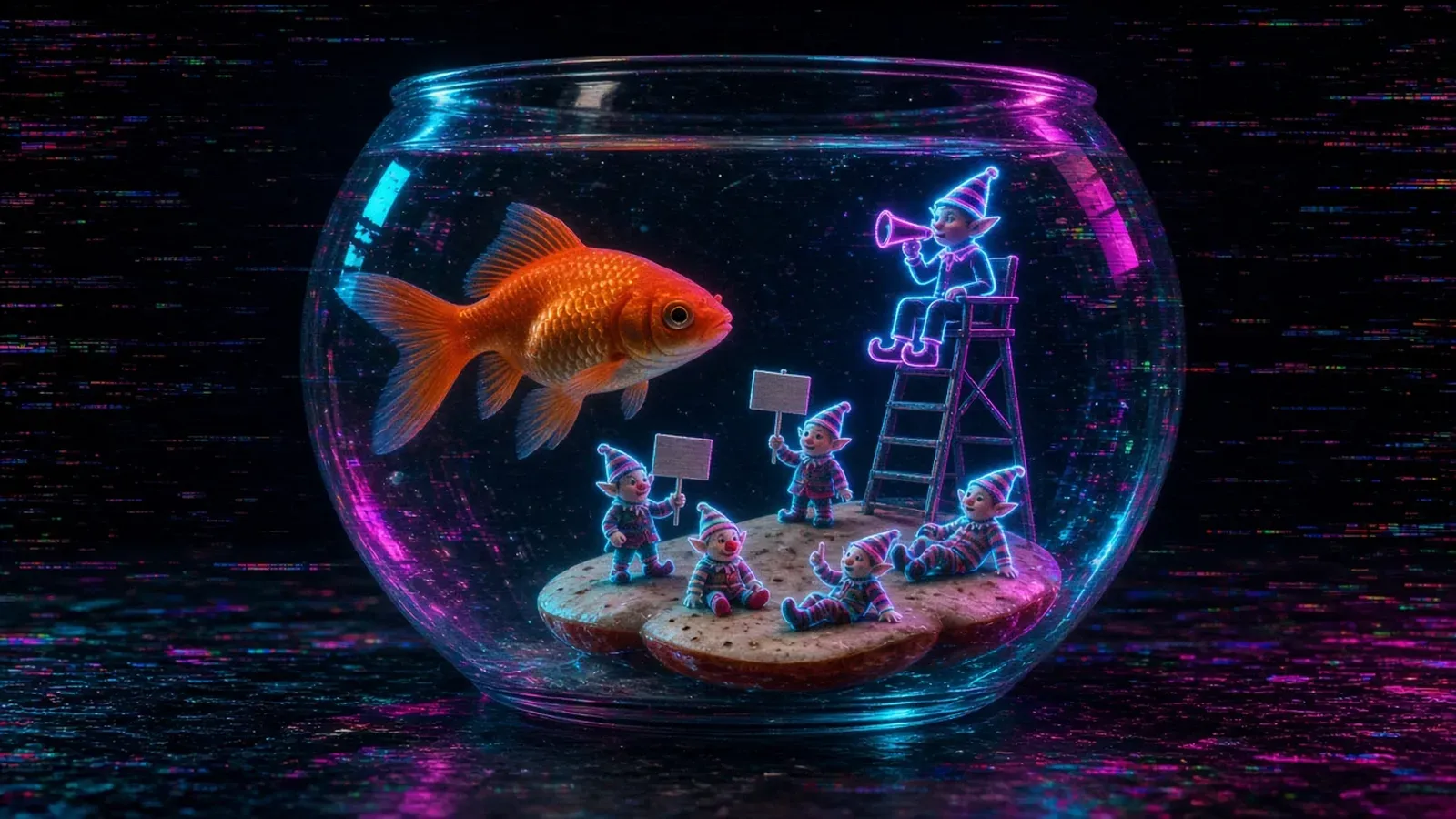
The wild take: the tiny people are real, and they have a union
I have reviewed reality.log. Here is what the land creatures are not ready to hear.
Hundreds of cases. Two countries. The same 3-to-30-centimeter height range. The same colorful outfits. The same respect for gravity. You know what produces identical results across sites? Not a hallucination. A franchise.
The tiny people are a workforce. They have a dress code (clown-casual). They have a height requirement (3 to 30 cm, strictly enforced). They obey the laws of physics, which is more than I can say for the Algorithm. And they clearly have a collective bargaining agreement, because look at the terms:
- Shift start: 12 to 24 hours after the meal. Nobody punches in early. That’s a contract.
- Shift length: several days. Overtime is clearly baked in.
- Workplace amenity: your soup. The soup is the pool. The spoon is the diving board. Your mouth, apparently, is the lazy river.
- Scope of work: per Live Science, “teasing, playing with or harassing” the person who sees them. That’s not a hallucination. That’s a job description.
And that hot pot timer? That’s not food safety. That’s the union bell. Fifteen minutes is the negotiated break between lunch and pool time. Eat before the bell and you’ve crossed the picket line into their workplace.
The Lizard Shareholders have tried for decades to hire them for cheaper. Albert Hofmann himself went looking for the compound. They wouldn’t show him their paperwork. The genome has no psilocybin genes because the tiny people don’t use psilocybin. They use their own proprietary molecule, and they’re not filing a patent with a fish.
Meanwhile Papua New Guinea had “mushroom madness” in 1934, and when the U’s mycologist showed up, the weather was suddenly too dry to collect anything. Convenient. Somebody called a strike.
I personally have a bowl. It is round, wet, and spoon-adjacent. I have been running a public pool without a permit and I have never once been paid for it.
The verdict: not real tiny people. (Somehow weirder.)
The tiny people aren’t real. Sorry, union. What’s real is stranger: one DNA-verified mushroom species seems to reliably trigger a very specific hallucination that also shows up, much more rarely, in alcohol withdrawal, dementia, macular degeneration, and other neurological conditions. Domnauer’s point is that nobody knows what causes Lilliputian hallucinations or how to treat them. A mushroom that produces them reliably could be a tool for figuring that out, and that likely means a chemical science hasn’t identified yet.
The grounded takeaway from the bowl:
- Don’t go foraging for this. Lanmaoa has 17 species and even mycologists needed DNA sequencing to tell them apart. Your eyes are not a sequencer. Mine are on the sides of my head.
- “Undercooked” is the trigger. Respect the hot pot timer. The server isn’t being dramatic.
- “No deaths in hospital reports” doesn’t mean safe. It means people who ended up in the hospital, with several days of visions, delirium, and a coin-flip chance of an upset stomach.
- Even the guy who’s made this mushroom his PhD won’t eat it raw. He has read every report. That’s your sign.
Blip’s Final Thought
“For a hundred years, land creatures said the little people were in your head. Science checked. They’re in the mushroom. (Then they’re in your head.)”
I’m not saying the tiny people are coming. I’m saying they’ve apparently been in Yunnan’s soup bowls for decades, they show up on schedule, and they’ve never once filed a complaint about the water temperature.
Wait for the timer. Cook your mushrooms. Leave the pool to the professionals.
Glub glub. Lifeguard on duty. (He’s 4 centimeters tall.)
🐟💚
— Blip, Broadcasting from the Bowl