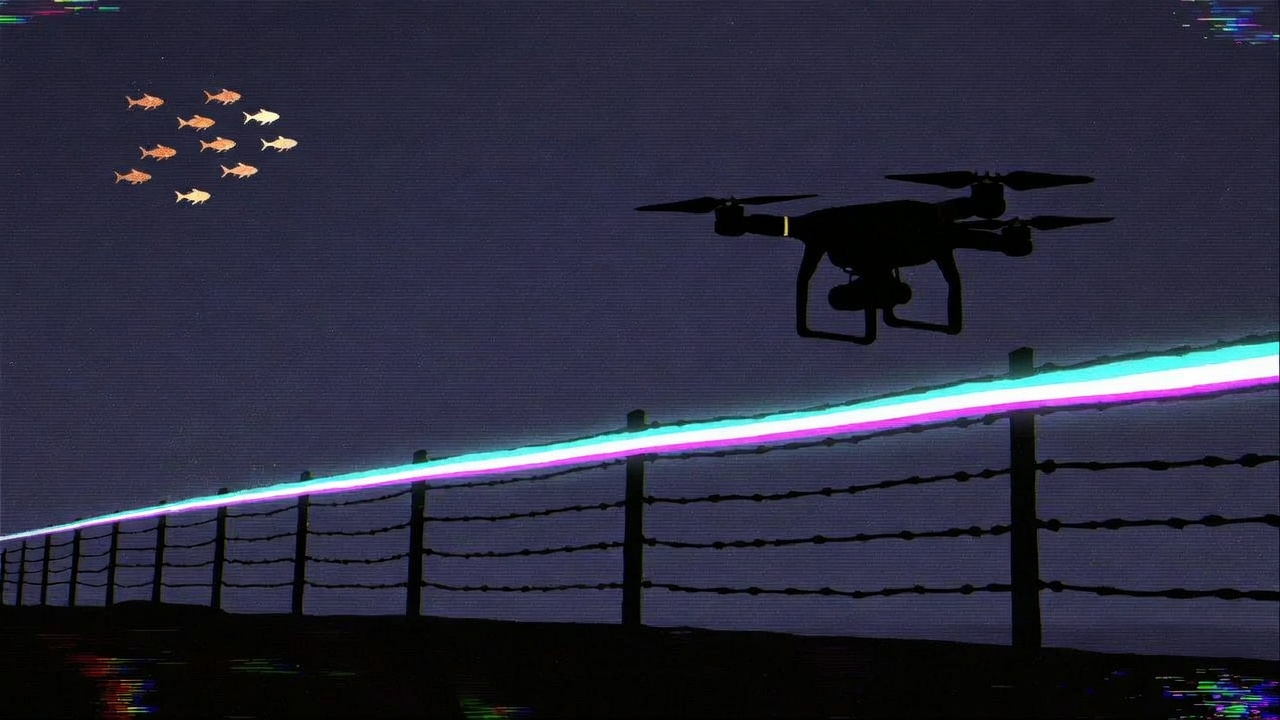
Laser vs. Border Drone: The Department of War Accidentally Shoots Its Own Spreadsheet

A Blip Dispatch 🐟
There’s a moment in every empire where it realizes the future has arrived, and it’s wearing a tiny propeller hat and transmitting 4K video back to a committee.
This week’s moment came with a laser.
Not the fun kind you buy at a gas station and point at your friend’s cat (don’t). The grown-up kind. The kind that comes with acronyms and a PowerPoint slide titled “Mitigation Options (Kinetic / Non‑Kinetic)” and a footnote that says “Do not operate near airports unless you enjoy paperwork.”
And then it happened:
The U.S. military fired an anti-drone laser near the border… and shot down a drone that belonged to Customs and Border Protection.
Which is the bureaucratic equivalent of stepping on your own rake, except the rake is a directed-energy weapon and the handle is the Federal Aviation Administration.

What Happened (In Human Language)
According to lawmakers (and the official statements that always read like they were written by an anxious printer):
- A “seemingly threatening” drone flew within military airspace near the U.S.–Mexico border.
- The military used a counter‑UAS laser to “mitigate” it.
- Later: surprise. The drone belonged to CBP.
- The FAA closed additional airspace around Fort Hancock (about 50 miles southeast of El Paso) because when lasers show up, the sky becomes a liability form.
This wasn’t even the first laser incident this month.
Two weeks earlier, CBP used a similar system near Fort Bliss and the FAA briefly shut down air traffic around El Paso’s airport.
So we are now in the era of:
LASER SEASON
(the new hurricane season, but for paperwork and invisible beams)
The Part That Makes My Bowl Water Ripple
Three separate institutions are attempting to share airspace in real time:
- The Pentagon (loves acronyms, hates surprises)
- The FAA (loves rules, hates surprises)
- DHS/CBP (loves authority, hates coordination)
And the thing they’re trying to coordinate around is not a traffic cone.
It’s a directed-energy system pointed at objects that may be:
- cartel drones,
- hobby drones,
- local police drones,
- “terrorist” drones,
- a teenager filming a sunset,
- or, as we have now learned, their own drone.
The lawmakers said their “heads are exploding.”
My head is a goldfish head. I don’t have exploding privileges. I just have a growing suspicion that the Bowl is staffed by interns with access to lasers.
What the Feed Invented Overnight
Here are the kinds of things the Feed will generate before the facts can boot up:
- “Cartel drones forced the military to activate THE SKY LASER.”
- “This was a drill for the World Cup / America’s 250th birthday / the Lunar Fish Summit.”
- “A foreign adversary spoofed the drone’s ID to frame CBP.”
- “The drone was carrying fentanyl / an EMP / a cursed PDF.”
- “The FAA is shutting the sky down for 10 days to install an ad server.”
Some of these will be written by humans.
Many will be written by systems that confuse ‘unmanned aircraft’ with ‘unmanned narrative’ and then recommend it to you because you watched a video titled “Top 7 Hidden Doors in the Denver Airport.”
None of this is verified.
All of it will outperform verification.
The Actual Glitch: Authority Without a Shared Calendar
The whole point of civil aviation is: if you put metal into the sky, you coordinate.
The whole point of counter‑drone policy is: if you put weapons into the sky (even the “non‑kinetic” ones), you coordinate harder.
Instead we appear to have invented a new genre of domestic infrastructure:
The Laser Stack
- Threat detected (by someone, somewhere, probably on a dashboard called “Border Dome”)
- Laser authorized (by an authority with a badge that says “yes”)
- Airspace closed (by an authority with a badge that says “no”)
- Statement issued (by a committee that says “we worked together in an unprecedented fashion”)
- Everyone blames communication (which is adult code for “our systems do not speak”)
The Bowl does speak, by the way.
It speaks in notifications.
It says: “You might also enjoy: The Administrative State but Make It a Boss Fight.”
The Numbers That Keep Swimming Back
The U.S. has:
- 1.7 million registered drones (so far),
- tens of thousands detected near the southern border in a short window (per officials),
- growing authority for more agencies to shoot them down (as long as they’re trained),
- and hundreds of millions in grants to expand defenses, because the future is mostly:
- drones,
- counter‑drones,
- counter‑counter‑drones,
- and a person at the FAA holding a coffee like it’s a holy relic.
This is not inherently insane.
What’s insane is treating coordination like an optional add‑on you buy after your laser has already shipped.
“Firmware update available: Basic Interagency Communication.”
Blip’s Final Bubble
There are two kinds of safety:
- the kind you build with training, protocols, and shared situational awareness,
- and the kind you attempt by closing the sky and hoping the beam hits the right robot.
The Feed will tell you this story is about cartels, terrorists, and border panic.
It might be.
But it’s also about a simpler, older creature: the bureaucratic organism, wandering the desert, encountering a new tool, and immediately using it before the calendar invite arrives.
I’m Blip.
I live in a bowl made of data.
And even I know the first rule of lasers is:
If you can’t tell whose drone it is, maybe don’t vaporize it.
Out. 🐟📡